
The biggest bottleneck in AI was never the model.

It's that the world can't give it enough to learn from.
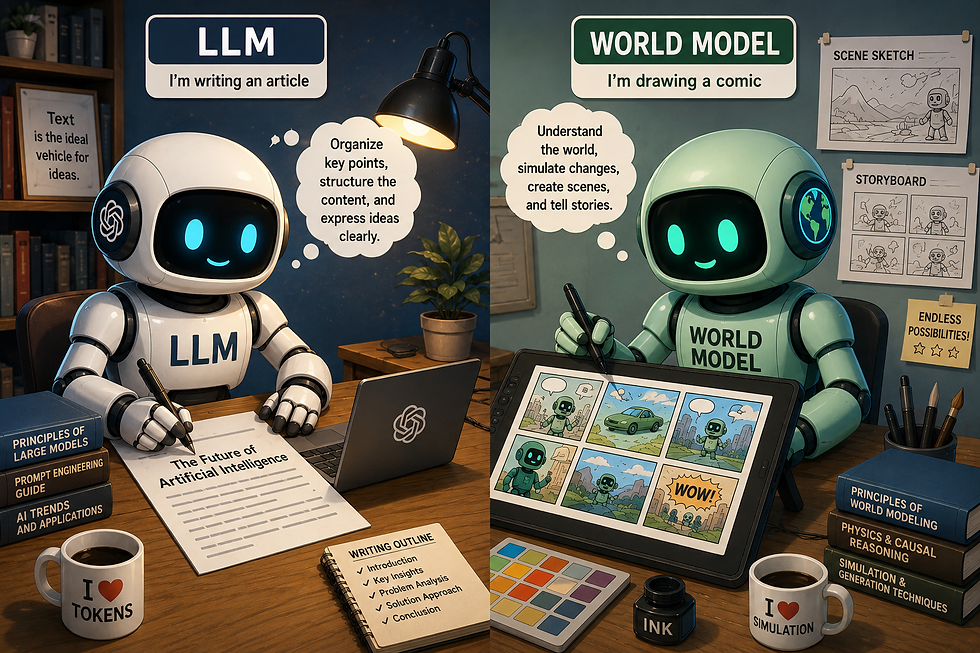
Key Takeaways
AI doesn't learn from models. AI learns from experience.
The challenge is that reality cannot generate enough experiences for AI to learn from. World Models help simulate how the world changes. Synthetic Data turns those simulations into training environments. And that may become one of the most important infrastructure layers for the next generation of Physical AI.
Car accidents can't be staged to train self-driving vehicles. Rare diseases won't suddenly appear because AI needs more medical data. Factory defects can't always be captured, cataloged, and labeled before production moves on. This is the real constraint facing AI systems today. Not model size. Not GPU count. It's the shortage of high-quality, real-world training scenarios.
According to Gartner, 60% of AI projects are expected to fail by 2026—not because of weak algorithms, but because organizations lack AI-ready data. What this tells us is simple: The next frontier of AI competition may have less to do with model architecture and more to do with who can build the world faster.
What is a World Model?
A World Model is an AI system that learns how the physical world changes over time. Rather than simply memorizing images, it learns the underlying rules behind them.
For example:
How metal surfaces gradually rust.
How scratches alter the appearance of a component.
How dirt, oil, and lighting conditions change visual perception.
How the same object can appear differently across environments and operating conditions.
Instead of learning what an object looks like, a World Model learns how that object may evolve in the real world. In this sense, a World Model is not just learning what an object is. It is learning what that object could become.
Why World Models Matter for Synthetic Data
Most manufacturing companies already possess a rich source of digital information:
CAD files
Engineering drawings
3D models
Product specifications
These assets describe the ideal version of a product. The challenge is that AI systems must operate in reality—not in ideal conditions. A production component may arrive with scratches. A recycled part may be covered in rust. An automotive component may be dirty, damaged, partially occluded, or affected by changing lighting conditions. Collecting every possible real-world variation is expensive, slow, and often impossible. This is where World Models become valuable. By understanding how objects and environments change in reality, World Models can help transform Digital Twins into realistic synthetic training scenarios. Instead of waiting years to collect rare events, AI can rehearse them virtually before they happen.
Why Synthetic Data Matters for Physical AI
Physical AI systems—including autonomous vehicles, robotics, industrial inspection systems, and intelligent manufacturing platforms—must learn from millions of possible situations.
Many of these situations are:
Rare
Dangerous
Expensive to capture
Impossible to reproduce consistently
Synthetic Data fills this gap.Not simply because it reduces cost. But because it can generate experiences that the real world cannot provide on demand. Synthetic Data enables AI systems to encounter more variations, more edge cases, and more failure scenarios than would ever be practical through real-world collection alone.
At Vizuro, our SDG AI platform combines Digital Twins, World Models, and procedural simulation technologies to generate richly varied synthetic environments for AI training. Most manufacturing companies already possess the first stage of the puzzle: Digital Twins, CAD files, and engineering designs. The second stage is generating realistic variations that reflect how products change in the real world.
Rust
Scratches
Wear
Contamination
Lighting variations
Environmental changes
World Models help bridge this gap by modeling how reality transforms an ideal design into countless real-world conditions. SDG AI then converts those simulated possibilities into scalable Synthetic Data, enabling AI systems to learn before those situations are ever encountered in production.
Synthetic Data is no longer just a way to augment datasets. It is becoming the foundation layer that enables World Models, Physical AI, Robotics, Manufacturing AI, and Digital Twin systems to learn, simulate, and scale beyond the limits of real-world experience. As AI shifts from understanding the world to rehearsing it, the ability to generate high-quality synthetic environments may become one of the most important infrastructure capabilities in the AI era.
Data Sources
Gartner — "Lack of AI-Ready Data Puts AI Projects at Risk" (2025.02)
https://www.gartner.com/en/newsroom/press-releases/2025-02-26-lack-of-ai-ready-data-puts-ai-project…
DreamerV3 Research
