
Building the Case for a Therapeutic Asset

Lessons from BioAsia Taiwan 2026 and recent research on how biology and evidence shape drug development decisions

Key Takeaways
AI drug discovery is moving beyond molecule generation. Recent work increasingly extends AI into target assessment, experimental planning, data interpretation, clinical development, and scientific decision support.
Model performance matters when it changes a development decision. Predictive accuracy has value when it helps teams generate more relevant evidence, resolve meaningful uncertainty, or make a better choice about a therapeutic program.
Faster experimentation does not automatically produce faster therapeutic learning. The value of a computational–experimental loop depends on whether its measurements are meaningfully connected to human biology and the development question at hand.
Apotek calls this broader perspective Asset Intelligence. It continuously evaluates how scientific, translational, development, IP, and commercial evidence changes the case for a therapeutic asset and identifies the evidence that should be generated next.
The Decision Bottleneck: What BioAsia Taiwan 2026 Revealed About AI in Pharma
At BioAsia Taiwan 2026, AI in medicine was discussed from very different directions. Speakers covered physics-based molecular modeling, automated experimentation, data generation, AI-native drug development, and the growing role of AI agents in research.
Together, these discussions reflected how quickly the technical scope of AI drug discovery is expanding. They also pointed to a more fundamental question:
What development decisions are these capabilities actually improving?
At Apotek, this question sits at the center of how we think about drug development: what evidence actually makes a therapeutic asset worth advancing?
For much of the past decade, progress has been described mainly through technical benchmarks. Models predict protein structures with greater accuracy, screen larger chemical spaces, generate more candidates, and shorten parts of the optimization cycle. These advances have materially expanded what computational drug discovery can do.
Therapeutic development, however, is not judged by how many possibilities a model can generate. Programs advance through repeated decisions about disease biology, intervention strategy, experimental design, patient context, and whether the available evidence justifies further investment.
A 2026 Nature Reviews Drug Discovery Perspective makes a closely related argument. Bender and colleagues note that many AI methods have been developed, applied, and benchmarked while evidence of clinically relevant impact remains limited. They argue that evaluation should move beyond model validation toward determining whether AI tools improve real drug-discovery decisions [1].
This distinction changes the standard by which AI should be judged.
A technically accurate model may still have limited development value if it addresses the wrong problem, relies on data that do not reflect its intended context of use, or produces an output that does not alter the next action. The relevant question is therefore broader than whether a model performs well.
The more useful test is whether AI helps a therapeutic team make a better decision.
At Apotek, this is also the starting point for what we call Asset Intelligence: evaluating not only individual predictions, but how new evidence changes the overall case for a therapeutic asset.
Better Molecules Still Depend on Strong Biology
Molecular optimization addresses only part of the uncertainty in drug development.
In an August 2026 industry essay, Daphne Koller proposed a useful decomposition of the problem. She separates drug discovery into disease-to-mechanism, mechanism-to-drug, and drug-to-patient challenges [2]. Much of the recent progress in AI has concentrated on mechanism-to-drug: structure prediction, molecular generation, protein design, and optimization across different therapeutic modalities.
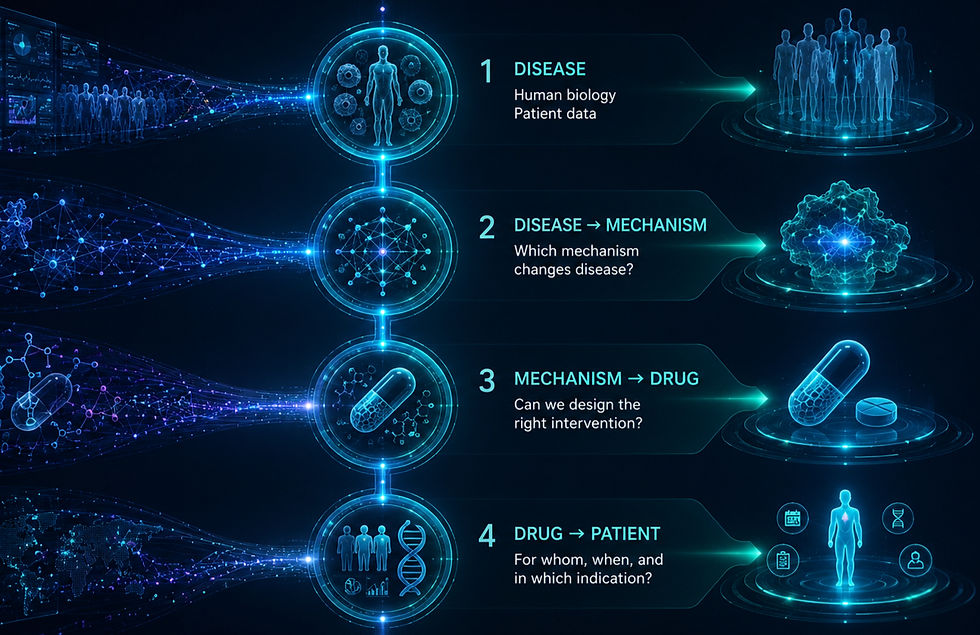
But when disease biology remains uncertain, better molecule design does not answer the most important question: will modifying this mechanism meaningfully change disease in patients?
Koller's article is an industry perspective rather than a peer-reviewed scientific review, but its framing is consistent with a broader shift in the literature toward target quality and translational relevance.
A 2026 Nature Reviews Drug Discovery Review by Pun and colleagues describes AI as playing an increasing role in target identification and assessment through the analysis of large datasets and complex biological networks [3]. The Review also emphasizes the gap between computational prioritization and true target validation. A highly ranked target remains a hypothesis; in the authors' framing, full validation is only achieved when a drug based on that target ultimately reaches regulatory approval [3].
This is an important boundary. AI can help identify patterns, integrate evidence, and prioritize biological hypotheses. Experimental and clinical evidence still determines whether those hypotheses are therapeutically actionable.
AI Is Moving Beyond Molecule Generation
A 2025 Nature Medicine Review surveys AI applications across disease-target identification, drug discovery, preclinical development, clinical studies, and post-market surveillance [4]. The examples span multimodal biological analysis, therapeutic target assessment, molecular and pharmacological prediction, synthesis planning, mechanism-of-action analysis, patient selection, and clinical operations.
This broader scope matters because therapeutic programs are built through connected decisions rather than isolated computational tasks.
Rentosertib provides one of the clearest current examples. A randomized phase 2a study published in Nature Medicine in 2025 evaluated the TNIK inhibitor in idiopathic pulmonary fibrosis [5]. The program combined AI-supported target identification with generative molecular design, and it subsequently entered Phase III development in July 2026 [6].
The example shows how AI can contribute across target identification, molecular design, and clinical development. It does not, however, establish that AI-enabled drugs have escaped the conventional risks of clinical development, nor that one workflow will generalize across diseases or modalities.
Its significance is more specific:
AI is increasingly participating in multiple development decisions across the life of an asset.
The next challenge is therefore not simply to expand the number of tasks AI can perform, but to determine whether those contributions produce stronger therapeutic programs. That requires evidence that the biology is relevant, that preclinical findings translate, and that each new experiment meaningfully reduces uncertainty around the asset.
Faster Learning Requires More Informative Experiments
Another recurring theme at BioAsia Taiwan 2026 was the connection between computation and experimentation.
Closed-loop approaches are increasingly designed around an iterative process:
Hypothesis → Prediction → Experiment → Evidence → Interpretation → Next Hypothesis
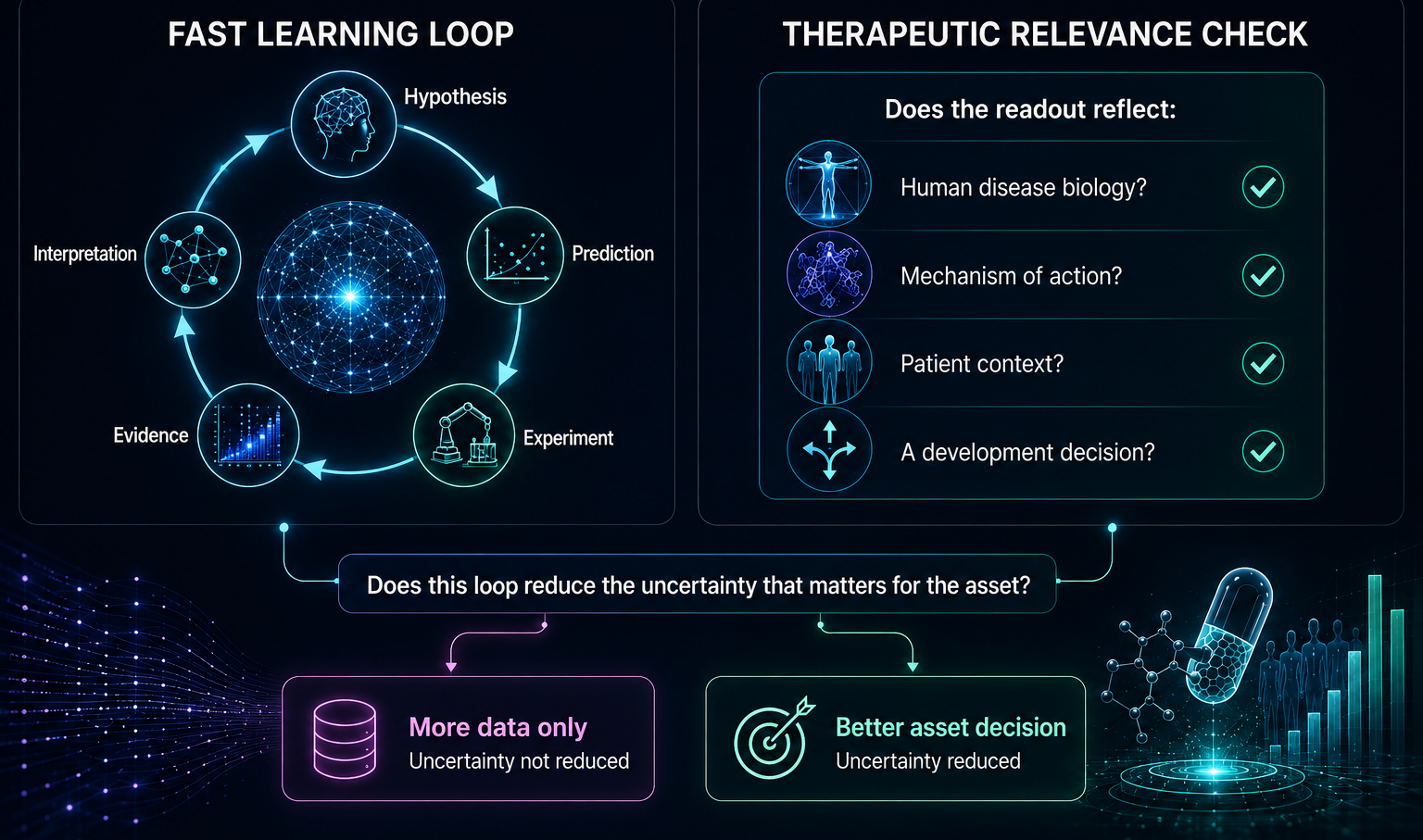
This structure is useful because a model does not simply produce a prediction and stop. Experimental results become new evidence that can update the next analysis or experimental choice.
Pun and colleagues include AI-driven closed-loop experimental platforms in their discussion of emerging target-discovery approaches [3]. Agentic AI is beginning to connect additional parts of the same process.
In 2026, Ghareeb and colleagues reported Robin, a multi-agent system that integrates literature research, hypothesis generation, experimental planning, data analysis, and revised hypothesis generation [7]. In a study involving dry age-related macular degeneration, the system proposed a drug-repurposing hypothesis, incorporated experimental findings, and generated a follow-up mechanistic hypothesis in an iterative lab-in-the-loop workflow.
The study is an important demonstration of how AI can participate in a scientific learning cycle. But the usefulness of any learning loop depends on what it is learning about.
Automated systems perform particularly well when progress can be measured using a fast and reliable score. Drug discovery and development rarely offer such a direct feedback signal. The outcome that ultimately matters is patient benefit, while molecular assays, cellular models, animal studies, biomarkers, and computational predictions are intermediate measurements. Their relationship to clinical outcome varies by disease and development context.
A faster experimental cycle can therefore produce more data without necessarily resolving the uncertainty that matters most for the therapeutic program.
A highly optimized assay may still be weakly connected to human disease. A potent compound may still act on a poorly selected target. An automated experimental workflow may produce technically valid results while leaving the most important question about the asset unresolved.
The objective should therefore be more specific than increasing experimental throughput.
A useful learning system needs to prioritize experiments according to the uncertainty they can resolve.
Apotek's View: From Better Decisions to Asset Intelligence
A biotechnology organization ultimately invests in a therapeutic asset, not in an individual model output. That asset is shaped by the relationship among its Target, Drug, and Indication.
These dimensions interact.

A biologically strong target may be paired with an unsuitable modality. A pharmacologically attractive drug may have been tested in the wrong disease context. An existing clinical asset may have failed in its original program while retaining pharmacology, safety information, or human exposure data that make redevelopment in another indication worth evaluating.
Three Entry Points to Therapeutic Asset Redevelopment
Drug discovery does not always begin from the same place.
Some teams begin with a Target and search for an intervention.
Others already have a Drug and need to determine where it has the strongest biological and clinical rationale.
A third group may begin with an Indication or unmet clinical need and work backward toward a mechanism and therapeutic strategy.
For this reason, Apotek treats Target, Drug, and Indication as three possible entry points into the same asset-development system, rather than as a fixed linear sequence.
This perspective is particularly relevant to drug asset redevelopment. Existing assets often arrive with an uneven evidence package: the molecule may already be characterized, while the indication, patient context, differentiation, or development strategy remains uncertain. The task is not necessarily to start discovery again, but to determine whether there is a stronger development path worth testing.
This is where we distinguish Decision Intelligence from Asset Intelligence.
Decision Intelligence
Decision Intelligence operates at the level of an individual choice:
What should the team do next?
It may support candidate selection, experimental prioritization, indication choice, or an advance/pause decision.
Asset Intelligence
Asset Intelligence operates at the level of the therapeutic program over time:
As new evidence arrives, is the case for this asset becoming stronger or weaker, and what evidence would most change that assessment?
In practical terms, Asset Intelligence asks whether each new piece of evidence is making an asset more—or less—worth developing.
We define Asset Intelligence as:
The continuous evaluation of whether the available scientific, translational, development, intellectual-property, and commercial evidence supports the next investment decision for a therapeutic asset, and what evidence should be generated next.
The term and the specific framework are Apotek's interpretation of where AI-enabled drug discovery and development should evolve. They are not conclusions presented by any single publication cited in this article.
A useful Asset Intelligence framework should make several things visible:
the strength and relevance of the current evidence;
the assumptions carrying the program;
conflicting findings;
the uncertainties that create the greatest development risk; and
the experiments most likely to change confidence in the asset.
It should also update as the program changes.
A new PK result may strengthen one interpretation of an efficacy study. A biomarker finding may shift the preferred patient population. A competing clinical result may alter differentiation or commercial positioning. Negative experimental evidence may indicate that further investment is no longer justified.
The purpose is not to eliminate uncertainty. The purpose is to make uncertainty explicit enough that teams can decide what to test, where to invest, and when to change direction.
Better Decisions Build Better Therapeutic Assets
AI drug discovery has made substantial technical progress. Biological and chemical spaces can be explored at a scale that was previously impractical, and increasingly complex parts of scientific work can now be supported computationally.
The main development challenge remains unchanged:
Can a particular intervention create meaningful benefit for a particular patient population?
Addressing that uncertainty requires computation, human biology, experimental evidence, and expert judgment.
AI becomes more useful when those inputs are connected around the therapeutic asset, rather than treated as separate analyses or isolated model outputs.
Recent research already points in this direction. AI is being applied to target assessment, experimental planning, clinical development, and iterative computational–experimental workflows [1, 3, 4, 5, 7]. The field is also beginning to evaluate AI by its effect on real scientific and development decisions rather than by model performance alone [1].
Apotek's Asset Intelligence framework builds on this shift.
The therapeutic asset is the unit of value. Target, Drug, and Indication provide different entry points, while scientific, experimental, clinical, IP, and commercial evidence continuously changes the case for further development.
For teams evaluating an existing therapeutic asset, the useful next step may be a new experiment, a different indication, a revised development strategy, or a decision not to continue.
Apotek works with biotech and research teams to identify potential redevelopment opportunities for existing drug assets, evaluating the evidence across Target, Drug, and Indication to determine which opportunities may warrant further validation.
If you're evaluating an existing drug asset and asking whether there may be another development path worth testing, we'd be interested in comparing notes.
👉Learn more about Apotek and our approach to drug asset redevelopment.
References
[1] Bender A, Thomas MC, Scannell JW, et al. Artificial intelligence in drug discovery—what it is, where we stand and the path forward. Nature Reviews Drug Discovery. Published August 7, 2026.
[2] Koller D. Drug Discovery Has No Magic Wands: On AI, Human Biology, and What It Will Actually Take to Discover Transformative New Medicines. a16z. Published August 3, 2026. Industry perspective.
[3] Pun FW, Podolskiy D, Izumchenko E, et al. Target identification and assessment in the era of AI.* Nature Reviews Drug Discovery. Published April 20, 2026.
[4] Zhang K, Yang X, Wang Y, et al. Artificial intelligence in drug development. Nature Medicine. 2025;31:45–59.
[5] Xu Z, Ren F, Wang P, et al. A generative AI-discovered TNIK inhibitor for idiopathic pulmonary fibrosis: a randomized phase 2a trial. Nature Medicine. 2025;31:2602–2610.
[6] Insilico Medicine. Insilico Medicine Initiates Phase III Clinical Trial of Rentosertib for Idiopathic Pulmonary Fibrosis. Company announcement. July 7, 2026.
[7] Ghareeb AE, Chang B, Mitchener L, et al. A multi-agent system for automating scientific discovery. Nature. 2026;655:497–505.
